
Dumbbell Workout Chart
A pair of dumbbells is enough to train every major muscle group. Tell this planner your goal, how many days a week you can train, your experience and whether you have a bench, and it builds a balanced dumbbell workout — squat, hinge, push, pull and core each week — with sets, reps and rest matched to your goal, ready to print with space to log your weights.
- Free to use
- No sign-up
- Runs in your browser
Dumbbell workout planner
Dumbbell Workout Chart Pack
Printable 2-, 3-, 4- and 5-day dumbbell workout plans, a 12-week progress log, an exercise form-cue sheet and a weekly training calendar.
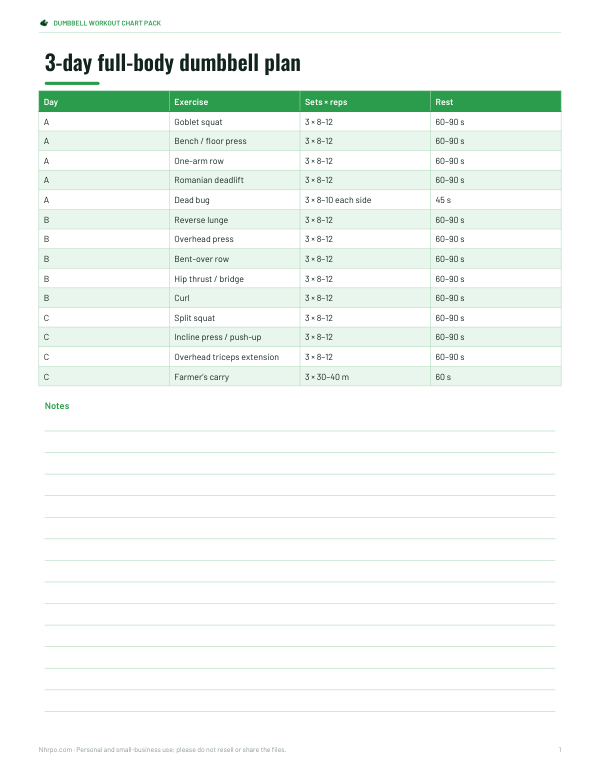
- 3-day plan (PDF/XLSX)
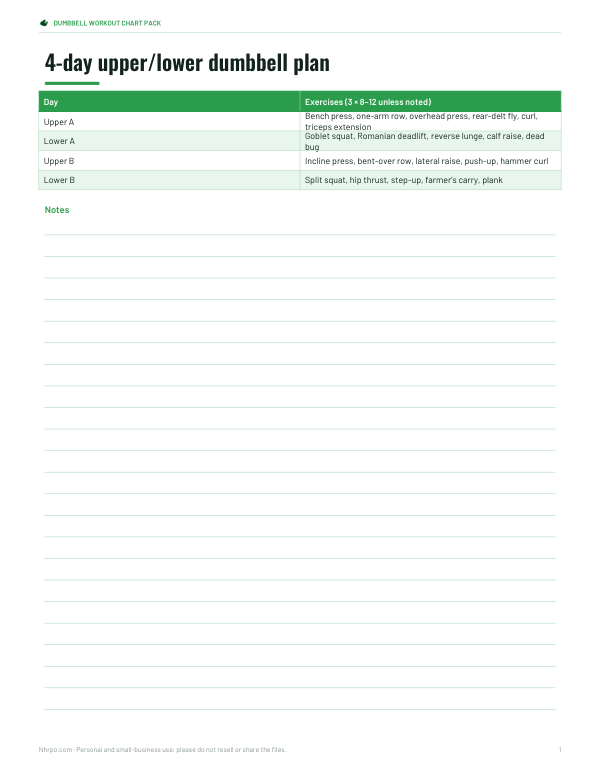
- 4-day plan (PDF/XLSX)
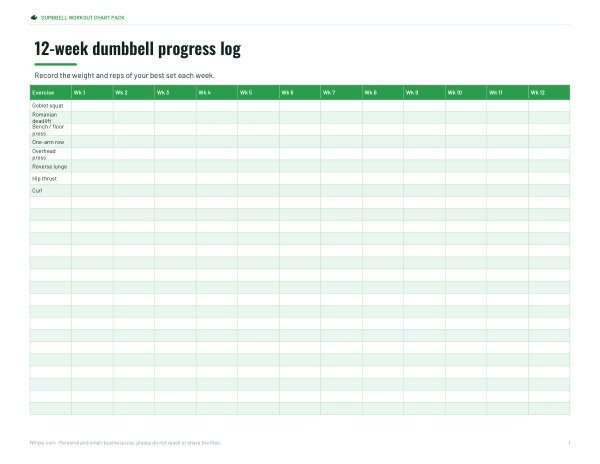
- Progress log (XLSX)
- Form cues (PDF/DOCX)
Formats: PDF, XLSX, DOCX. Instant download after payment (link valid 72 hours, up to 5 downloads). AI-assisted: the templates were drafted with AI help and reviewed and laid out before publishing.
$3.00 USD, one-time 4 files · about $0.75 each
- Instant download
- 7-day refund
- Secure checkout by Stripe
7-day money-back guarantee. Full refund within 7 days of purchase, even after you download.
Free sample: 12 Week Progress Log (PDF, 63 KB)
Full refund within 7 days — see the refund policy and license.
Free printables
Single sheets you can print right now, no sign-up. The full pack adds every sheet in one download plus the editable files.
 Printable Dumbbell Form Cues
How the plan is built
Every plan covers the main movement patterns each week — a squat, a hip hinge, a single-leg exercise, a horizontal push and pull, a vertical push and core work — so no major muscle group is left out. The split depends on how many days you train: full-body sessions for two or three days, upper/lower for four, and push/pull/legs plus upper and lower for five. Sets, reps and rest follow your goal, and beginners start with one fewer set per exercise.
Sets, reps and rest by goal
| Goal | Sets × reps | Rest | Load |
|---|---|---|---|
| Strength | 4 × 5–6 | 2–3 minutes | Heavy — the last rep is hard |
| Muscle (hypertrophy) | 3 × 8–12 | 60–90 seconds | Moderate — stop 1–2 reps before failure |
| Muscular endurance | 3 × 15–20 | 30–45 seconds | Light to moderate |
These are widely used starting points. Muscle growth can happen across a wide range of rep counts as long as sets are taken reasonably close to failure; heavier, lower-rep work builds maximal strength best.
Exercise library by muscle group
| Muscle group | Dumbbell exercises |
|---|---|
| Quads and glutes | Goblet squat, reverse lunge, split squat, step-up |
| Hamstrings and glutes | Romanian deadlift, hip thrust, glute bridge |
| Chest | Bench press, floor press, incline press, push-up |
| Back | One-arm row, bent-over row, rear-delt fly |
| Shoulders | Overhead press, lateral raise |
| Arms | Curl, hammer curl, overhead triceps extension |
| Core and grip | Dead bug, plank, farmer’s carry |
| Calves | Single-leg calf raise |
Worked example: three days a week for muscle
An intermediate lifter choosing “muscle” and three days gets three full-body sessions. Day 1: goblet squat, bench press, one-arm row, Romanian deadlift and dead bug, each 3 × 8–12 (dead bug 8–10 per side) with 60–90 seconds’ rest. Day 2 and Day 3 rotate lunges, split squats, overhead and incline presses, bent-over rows, hip thrusts, curls, triceps extensions, planks and carries. That adds up to 51 working sets a week — about 15–20 per session, which fits in 45–60 minutes.
Choosing dumbbell weights
- Pick a weight you can lift for the target reps with good form, finishing with one or two reps left in the tank.
- Lower-body and back exercises usually need heavier dumbbells than shoulders and arms.
- Adjustable dumbbells are the most space-efficient way to cover a range of weights.
- Use double progression: stay at one weight until you hit the top of the rep range on every set, then go up.
- Log your weights on the printed chart to see progress.
Training without a bench
Choose “No” for the bench and the planner swaps bench-dependent exercises for floor or standing versions: floor press instead of bench press, push-ups instead of incline press, glute bridges instead of hip thrusts and split squats instead of step-ups. These still train the same muscles effectively, with a slightly shorter range of motion on the floor press.
Warm-up routine
Before each session, spend five minutes on light cardio or brisk marching, then do a short circuit of bodyweight squats, hip hinges, arm circles and push-ups against a wall. For the first exercise, do one or two lighter sets with about half your working weight. This prepares joints and muscles and lets you check your form before the heavier sets.
Progressing over the weeks
| Weeks | Focus |
|---|---|
| 1–2 | Learn the movements with lighter weights; finish sets with 3 reps in reserve |
| 3–6 | Add reps each week until you reach the top of the range |
| 7–10 | Increase weight when the top of the range is reached on all sets |
| 11–12 | Keep weights, but reduce volume for an easier week before the next block |
If you run out of heavier dumbbells, slow down the lowering phase, add a pause, do more reps, or switch to a single-leg or single-arm version to keep making the exercise harder.
Safety and form
- Warm up with 5 minutes of light movement and one or two lighter sets.
- Keep your back neutral on rows and Romanian deadlifts — hinge at the hips.
- Control the lowering phase; don’t drop into the bottom of squats or presses.
- Stop an exercise that causes sharp pain, and seek advice if it persists.
- If you have a medical condition, are pregnant or are returning from injury, check with a healthcare professional first.
Printable pack
The optional pack includes printable 2-, 3-, 4- and 5-day dumbbell plans, a 12-week progress log, an exercise instruction sheet with key form cues and a weekly training calendar. The planner above is free.
AI-assisted content
This page was drafted with AI assistance and reviewed before publishing. It is general fitness information, not medical advice.
Frequently asked questions
Can you build muscle with only dumbbells?
Yes — with enough weight range and progressive overload, dumbbells can train every major muscle.
How many days a week should I train?
Two to four days suits most people; three full-body days is a common starting point.
How heavy should my dumbbells be?
Heavy enough that the last one or two reps of each set are challenging with good form.
What if I don’t have a bench?
Use floor presses, push-ups and glute bridges instead — the planner swaps them automatically.
How long should a dumbbell workout take?
About 45–60 minutes for four to six exercises.
Can I print the plan?
Yes, with a column to write in your weights.
Should I train to failure?
Not every set — stopping one or two reps short keeps quality high and recovery manageable.